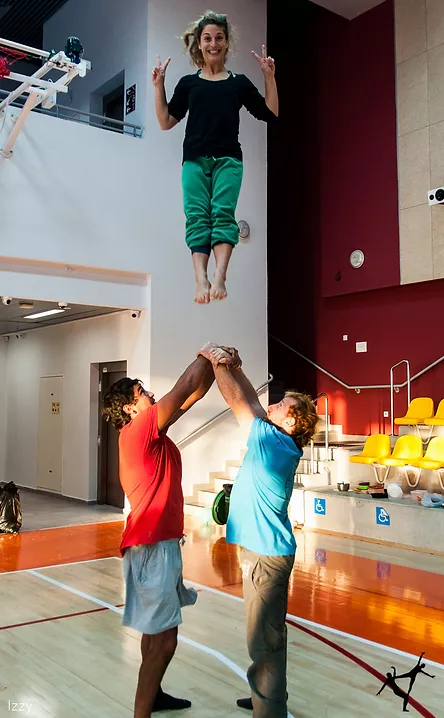
In general, different people have different ways to set acro levels. Some will emphasize experience, and others will emphasize technique and ability or awareness and understanding of how the body works. Also there are people who are more advanced in floor postures and less in standing, or vice versa. You may be very advanced with a particular partner but not used to working with others. Always remember that what determines is where you are today and not what you could ever do… Given the above, we have created some general points in the hope that it will help you find the right level for you.
As a rule, the levels refer to the base or flyers. There is no need to be proficient in poses, both as a base and as a flyer.
In acro events in Israel we use 4 levels:
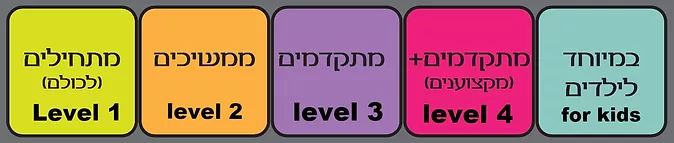
Level 1 Beginners (green)
These classes are open to all. Participants include people who are inexperienced and those who are familiar with basic exercises such as airplane, star, bat, titanic and transitions between these poses. Remember that a successful learning of the basics provides a basis for all practice!
Level 2 Intermediate (orange)
Designed for people who feel comfortable also postures like inverted star, standing on hands (lying down), standing on shoulders (standing base), foot to hand (lying base). Level 2 People usually practice low hand to hand and transitions of washing machines such as Ninja, Four-Step, Katherines Wheel, etc. This is usually at least a year of experience and even more.
Level 3 Advanced (purple)
Classes suitable for those who feel comfortable in positions such as Free-Star, Pete to Pete, Hand to Hand in straight hands on a lying base, and perform complex and flowing transitions in long sequences, including dynamic jumps. Practitioners at this level usually work on standing to hand while standing, reverse hand to hand, balances of one leg or one hand and more.
Level 4 Very Advanced (red)
These classes are for the very advanced and professionals. At this level people are familiar with and perform a wide range of transitions and postures while lying down and standing confidently and without guarding. They usually stand steady hand-to-hand while standing, and / or practice very complex transitions on the floor. Work on hand-to-hand and foot-to-hand while standing with straight hands, balances with one hand, podska, corvette, cascade, etc.